

Know your rights (KYR) & Get Prepared
Every person in the United States has constitutional rights, regardless of immigration status. Understanding these rights and being prepared for an encounter with federal law enforcement is essential.
know what to do…
if you Encounter federal agents
As discussed in the resources linked below, if you find yourself interacting with an immigration officer in any location including your workplace, or out in the community, remember that
YOU SHOULD:
Remain calm and keep your hands where the officer can see them
YOU HAVE THE RIGHT TO:
Remain silent when questioned or arrested by immigration officers
NOT discuss your immigration or citizenship status with the police, immigration agents, or other officials
NOT sign anything you do not understand. Instead, state that you wish to speak with an attorney
Learn more about your rights if you encounter federal agents, including what to do in specific situations, like if you are in your car, outside, or if an immigration officer knocks on your door:


General Know Your rights
Know Your Rights recap
if federal agents approach your vehicle
add text from FAQ
if you are Traveling
Learn about your rights when encountering law enforcement at the airport:
If you are undocumented, learn more about your rights and protections if you are traveling within the United States:
link to topics for more info
Consider creating a Travel Emergency Preparedness Plan and sharing it with a trusted family member, friend, or attorney in case of an emergency.
if federal agents show up at immigration court
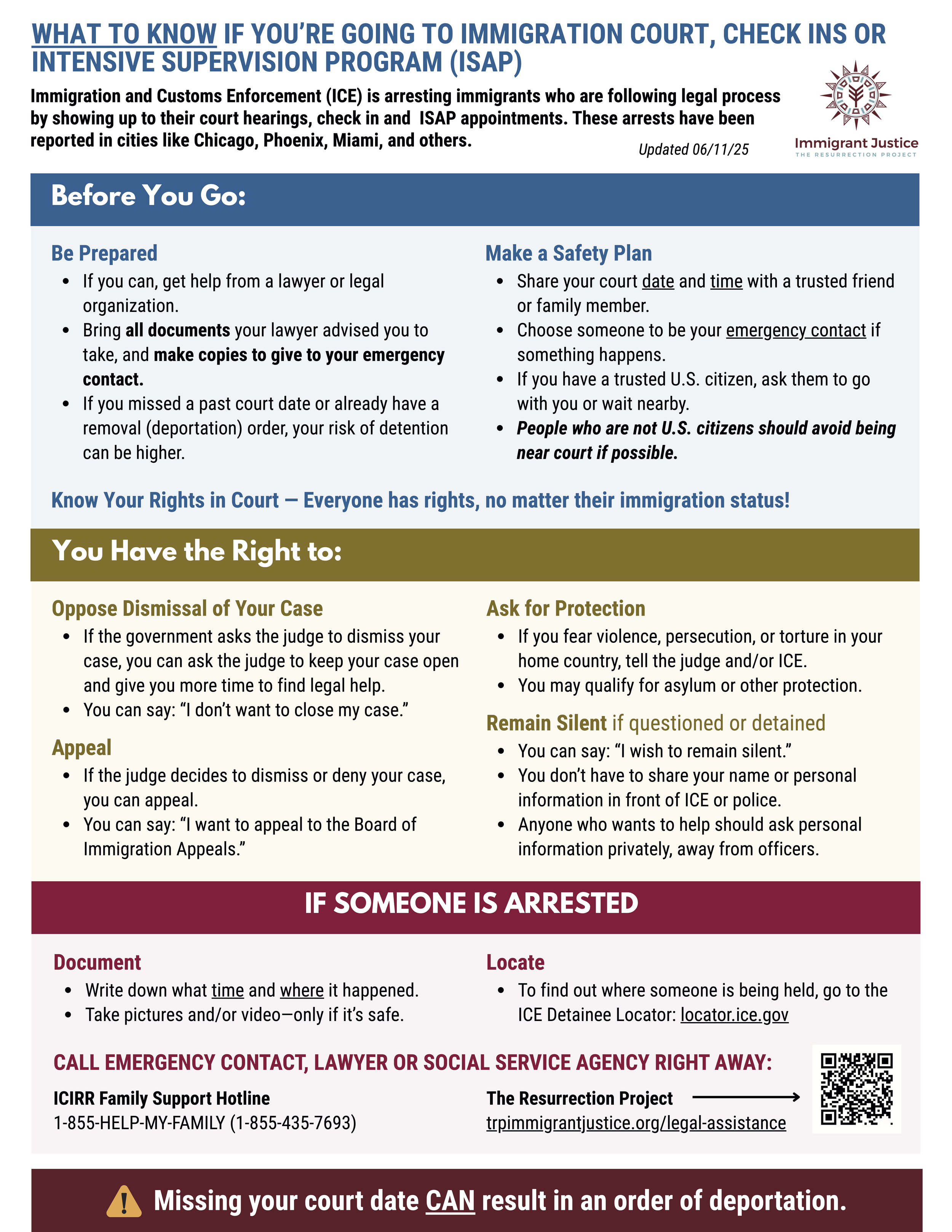
U.S. Immigration and Customs Enforcement (I.C.E.) has started making arrests at immigration courts across the country.
If you have been in the United States for less than two years and are scheduled for court, the government may try to terminate or dismiss your case in immigration court removal proceedings to place you in a process called expedited removal.
Know that not attending your hearing could result in an “in absentia” deportation order. Seek a consultation with a qualified legal practitioner if you have not already had one.
Learn more about your rights at immigration court, including what you can do before and during your hearing if the government seeks to terminate proceedings:
Download the fact sheet on What to Know if You're Going to Immigration Court, Check-ins, or Intensive Supervision Program (ISAP):
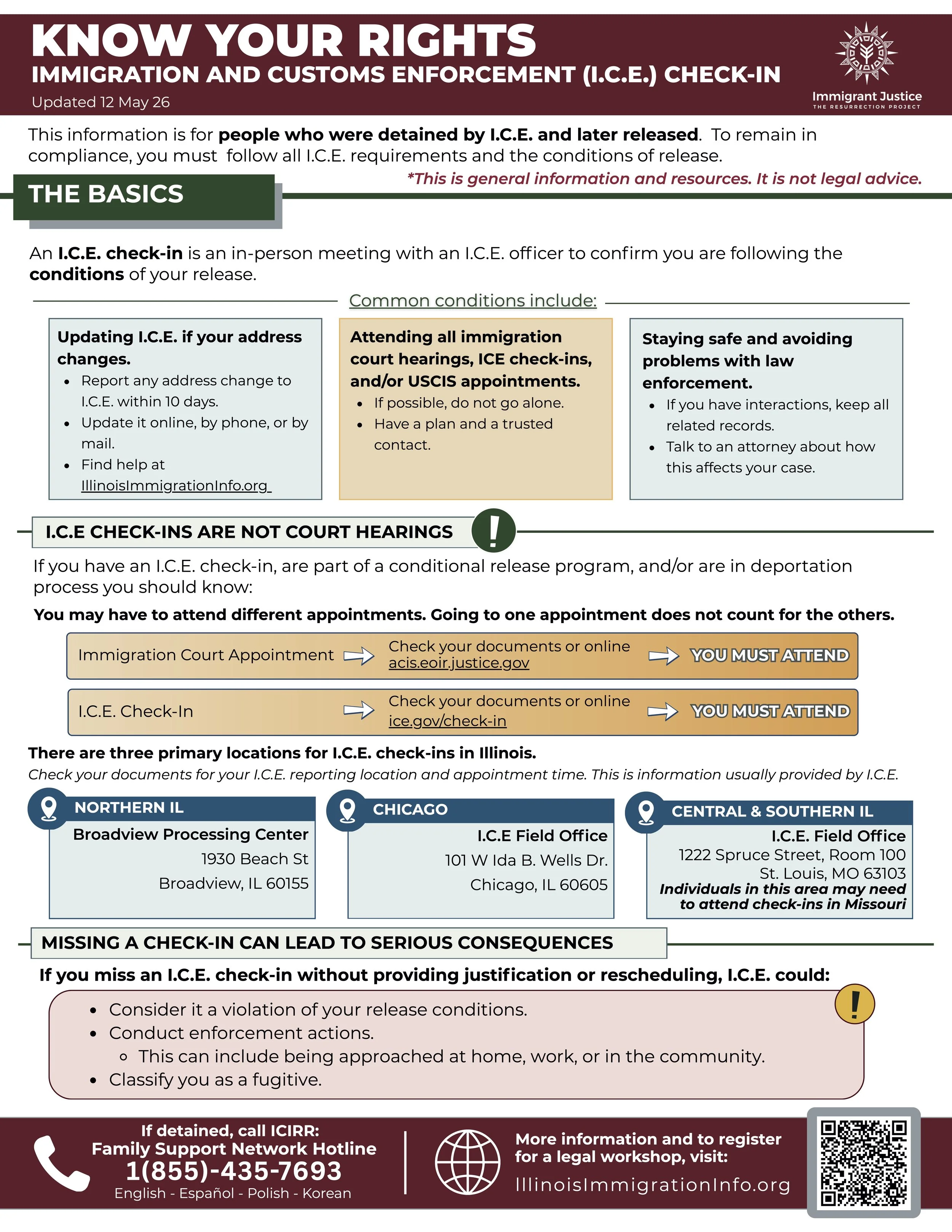
Download the KYR Immigration and Customs Enforcement Check-In information sheet:
This document is available in these languages:
English
Spanish
French
Haitian Creole
Dari/Farsi
Pashto
Korean
Arabic
if you receive a "Respondent's Pleading Declaration" or similar form
In Spring 2026, some immigration courts began holding status hearings where dozens of unrepresented individuals are scheduled to appear at the same time. These individuals may be given a deadline to fill out a form sometimes titled “Respondent’s Pleading Declaration.” Completing this form may result in an immigration judge finding that the person signing can be deported from the United States unless they apply for and are granted relief from removal.
This resource provides information about your rights if you receive a “pleading declaration.” Download the guide Know Your Rights: Responding to Pleading Declarations:
KNOw your Rights TOolkit
These resources provide a toolkit for immigrant families to protect their rights and navigate potential legal interactions with confidence.
KYR Door Signs
You can also print a sign to put on your front door to communicate your rights and preferences without opening your door.


Download a door sign in:
KYR cards
A Know Your Rights Card is a small wallet-sized card that you can download, print, complete, and keep with you to communicate your rights.


Download a card in:
Attend a training or workshop
Know Your rights trainings
Immigrant Justice at the Resurrection Project (TRP) hosts Know Your Rights trainings, both in-person and virtually, to ensure that communities are well-equipped to protect themselves and loved ones. Various trainings are available to help individuals, families, and organizations understand their rights and prepare for potential encounters with federal authorities. Each training provides clear tools and resources for learning and preparation.
(available in English & Spanish)
Legal Assistance workshops & Clinics
Legal assistance workshops & clinics are legal service events where many people can access legal consultations and support applying for immigration relief at the same time. During a workshop, you will be able to talk directly to a legal expert about your specific needs, hear legal advice, and learn what options you and your family may have. In some cases, you may be asked to return another day to complete an application or may be referred to another organization to access direct legal services.
During a legal workshop or clinic, you will have access to a legal expert, but you will not be given an attorney to represent you in your case long term.
See sections below to find legal help based on your needs:
-
Immigrant Legal Support Program
Immigrant-serving organizations across the state provide free immigration assistance to eligible immigrants living in Illinois through the Immigrant Legal Support Program.
Services: Legal screenings, application help, preparation and accompaniment to an ICE check-in appointment or Immigration Court hearing.
Location: Statewide
Cost for Illinois Residents: Free
-
Recent Arrivals Workshop
The National Immigrant Justice Center’s free legal workshop for immigrants living in the Chicago area who arrived in the United States on or after September 15, 2022 and are considering applying for asylum.
Services: Asylum
Location: Chicago
Cost for Illinois Residents: Free
-
Citizenship & DACA Assistance
New Americans Initiative partner organizations offer office legal consultation to citizenship and/or DACA applicants on specific dates and times.
Services: Citizenship, DACA Renewal
Location: Statewide
Cost for Illinois Residents: Scholarships may be available for applicants with financial need
Create a family Emergency Plan
Start a family emergency plan and talk to your children or dependents about it to ensure everyone knows what to do in case of an emergency. See a step-by-step guide on how to develop a plan for yourself and your family:
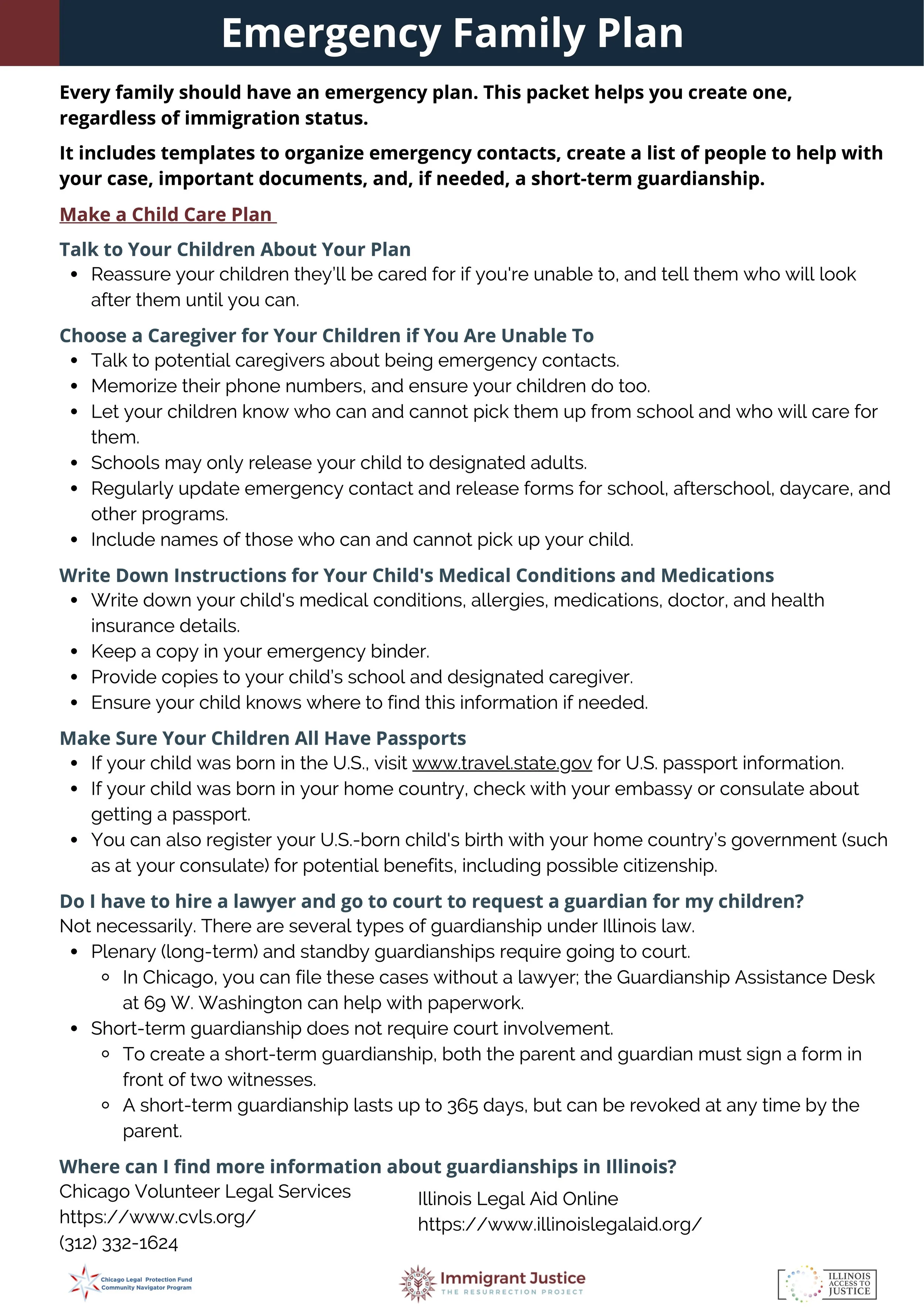
This document is also available in these languages:
Learn more about how to create a family emergency plan:
Consider guardianship options
You should think about who will care for your children if you are detained or deported. This is an essential part of safety planning. However, not everyone will need a court-appointed legal guardian. You should be aware that a guardianship will give the guardian the right to make decisions concerning your children, including whether to allow your children to see you. It may be difficult to terminate a guardianship if you change your mind. You should consult with an attorney before seeking a guardianship.
Learn more about things you should consider when deciding if you want to pursue a potential guardianship for your family:
Guardianship documents allow you to legally designate a trusted adult to care for your children if you are unable to do so. These documents can specify who will make decisions about your children’s education, healthcare, and daily needs.
Learn more about short-term guardianship from Illinois Legal Aid Online (ILAO):
(available in English & Spanish)
The Loyola University Chicago School of Law has published an updated Guide for Parents in Illinois who are Undocumented that offers guidance on child care safety planning and the child welfare system:
protect your assets
Learn more about steps to take to protect your financial assets and consider establishing a financial power of attorney:
-
A Power of Attorney document is a written document that grants a designated person (your “Agent”) authority to act on behalf of the person giving the power of attorney in some matters. The authority of the Agent may be broad or limited and may allow decisions regarding finances, medical treatment, and/or property. A power of attorney is not a standardized, “one size fits all” form. Power of attorneys are not guardianships and an Agent who has authority under a power of attorney is usually not authorized to care for or make decisions on behalf of one’s children.
-
Not everyone needs a power of attorney. Each person should consider whether a power of attorney is right for them based on their individual circumstances. A power of attorney may be useful because it can be used to allow a trusted friend or family member to access your bank account. If you do not have a bank account in the United States or other substantial financial assets, there may not be a compelling reason to complete a power of attorney. Many banks allow customers to manage their accounts from outside the United States, so if someone is deported, they will generally be able to access their resources from abroad.